Remote Psychoeducational Testing: What Schools Are Gaining, What They’re Losing, and What We Can’t Ignore
Not long ago, the idea of completing a psychoeducational evaluation without sitting across a table from a student felt unthinkable. Testing meant sharpened pencils, test easels, manipulatives spread across a desk, and a quiet room where subtle behaviors told as much of the story as the scores themselves.
Then the pandemic hit. Schools adapted overnight. Remote learning became necessary, and with it came remote assessments. What began as a stopgap has quietly become something more permanent. Today, many districts are asking whether remote psychoeducational testing should remain part of standard practice.
The honest answer is complicated.
Remote testing offers real advantages. It also carries real risks. And pretending otherwise does a disservice to students, families, and professionals alike.
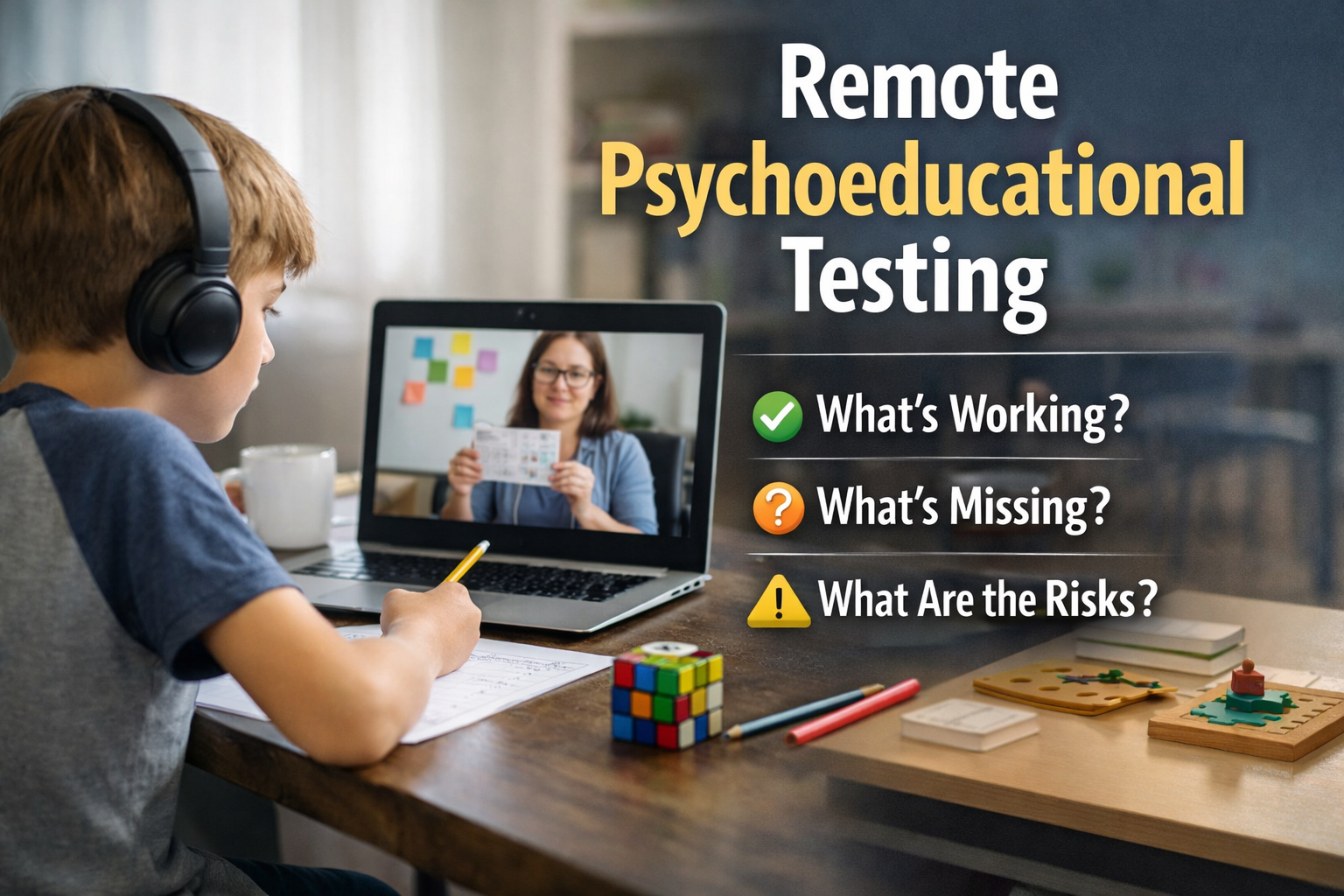
Student participating in a remote psychoeducational testing session.
What Remote Testing Gets Right
Accessibility is the strongest argument in favor of remote psychoeducational testing.
For rural districts, understaffed schools, or regions facing chronic shortages of school psychologists, remote assessments can reduce long waitlists. Students who might otherwise wait months for an evaluation may be seen sooner. In some cases, remote testing makes services possible where they otherwise wouldn’t exist at all.
Remote formats can also be less intimidating for certain students. Some children feel calmer in their own homes. For students with anxiety, selective mutism, or medical needs that limit in-person attendance, remote assessment can lower barriers and reduce stress.
There are also practical benefits for schools. Remote assessments can reduce travel time, allow flexible scheduling, and create opportunities for collaboration across districts. In theory, this efficiency could mean more students served with fewer delays.
These benefits are real. They deserve acknowledgment.
But they are only part of the picture.
What Remote Testing Misses
Psychoeducational assessment is not just about test administration. It is about observation, interaction, and context.
When a student is in the room with you, you notice things that don’t appear on score reports. You see how they approach a new task. You watch how they handle frustration, novelty, or correction. You observe fine motor coordination, eye contact, impulsivity, persistence, and fatigue. You notice when effort drops or anxiety spikes.
Remote testing filters these observations through a screen.
Camera angles limit what you can see. Lag and audio issues interrupt flow. Caregivers may unintentionally cue students. Environmental distractions are harder to control. Even when everything goes smoothly, something essential is altered: the shared physical space where subtle behaviors unfold naturally.
For younger students, these concerns multiply. Developmental assessments rely heavily on rapport, play-based interaction, and hands-on materials. Asking a five-year-old to attend to a screen for extended periods is not the same as engaging them in person, no matter how skilled the examiner may be.
Equity Concerns We Can’t Overlook
Remote testing assumes a level playing field that does not exist.
Not all families have reliable internet access. Not all homes provide quiet, distraction-free spaces. Some students share rooms, live in noisy environments, or rely on unstable devices. These factors introduce variability that has nothing to do with ability and everything to do with circumstance.
Students with attention difficulties, sensory sensitivities, or executive functioning challenges may be disproportionately affected. What looks like inattention on screen may be environmental overload. What appears as noncompliance may be frustration with technology rather than task demands.
If we are not careful, remote testing risks amplifying inequities rather than reducing them.
Validity, Ethics, and Professional Responsibility
“Most standardized cognitive and assessment measures were developed for in-person administration.”
Most standardized cognitive and academic measures were developed for in-person administration. While publishers have issued guidance for remote use, guidance is not the same as equivalence.
School psychologists are ethically obligated to use instruments appropriately, interpret results cautiously, and clearly document limitations. When testing conditions deviate from standardization, those deviations matter.
Remote assessment requires more than technical competence. It requires professional judgment, transparency, and humility. We must be willing to say when results should be interpreted with caution and when in-person follow-up is necessary.
This is not a failure of skill. It is a mark of professionalism.
What Parents Experience
Families often appreciate the convenience of remote evaluations, especially when transportation or scheduling is difficult. But many parents also report confusion about the process. They may not understand their role during testing, worry about doing something “wrong,” or feel unsure whether results truly reflect their child.
Clear communication is essential. Parents need to know what remote testing can and cannot tell us, what supports are acceptable during testing, and how results will be used in decision-making.
Trust is built not by overselling remote assessment, but by being honest about its limits.
A Balanced Path Forward
The question is not whether remote psychoeducational testing is good or bad. The better question is when it is appropriate and how it should be used responsibly.
Remote assessment may be suitable for:
• Older students with strong attention and technology skills
• Follow-up evaluations or progress monitoring
• Rating scales, interviews, record reviews, and certain academic measures
• Situations where in-person assessment is not feasible and delays would cause harm
In-person assessment remains critical for:
• Young children
• Initial evaluations involving cognitive or developmental concerns
• Complex learning, attention, or behavioral profiles
• Situations where observational data is essential
Hybrid models may offer the best solution. Interviews, rating scales, and record reviews can occur remotely, while hands-on testing and observations happen in person. This approach balances access with accuracy.
What Schools Should Be Asking Right Now
Before expanding remote testing, districts should pause and reflect.
Are we prioritizing student needs or system convenience?
Are we documenting limitations clearly?
Are we providing training and support for ethical decision-making?
Are families informed partners in this process?
Technology can extend our reach, but it cannot replace professional judgment or human connection.
Recommended Online Resources and Books
For educators and school psychologists wanting to deepen their understanding, the following resources offer thoughtful guidance:
Online Resources:
National Association of School Psychologists (NASP): Telehealth and Teleassessment Considerations
https://www.nasponline.org/resources-and-publications/resources/considerations-delivery-school-psychological-telehealth-services
Practical guidance on ethical, legal, and professional considerations when delivering school psychological services remotely.
American Psychological Association (APA): Guidelines for the Practice of Telepsychology
https://www.apa.org/about/policy/telepsychology-revisions
Authoritative ethical and practice standards for telepsychology, including assessment, confidentiality, and competence.
Standards for Educational and Psychological Testing (AERA, APA, NCME)
https://www.aera.net/publications/books/standards-for-educational-psychological-testing-2014-edition
The foundational document outlining technical and ethical expectations for test use, interpretation, and decision-making.
Buros Center for Testing: Standards, Codes, and Guidelines
https://buros.org/standards-codes-guidelines
A centralized resource for assessment standards, ethical codes, and professional testing guidance.
WPS Telepractice Resources
https://pages.wpspublish.com/telepractice-101
Publisher guidance on telepractice implementation, limitations, and appropriate use of assessment tools.
Pearson Telepractice Overview
https://www.pearsonassessments.com/professional-assessments/digital-solutions/telepractice/about.html
An overview of remote assessment platforms and considerations from a major test publisher.
Books:
Selecting assessment tools and interpreting results responsibly matters more than ever, especially as remote and hybrid evaluation models become more common. The following books and resources provide a strong foundation in ethical assessment, professional judgment, and student-centered decision-making. Whether you are new to school psychology or a seasoned practitioner navigating changing assessment conditions, these readings offer guidance grounded in both research and real-world practice.
Essentials of Psychological Testing
Susana Urbina
ISBN-13: 978-1118680483
This book is a gold standard for understanding the foundations of psychological and educational assessment. Urbina does an excellent job explaining reliability, validity, standardization, and ethical interpretation in a way that connects theory to real-world practice. For school psychologists navigating remote or hybrid testing, this text is especially valuable because it reinforces why testing conditions matter and how deviations from standardization affect interpretation. Best for graduate students, early-career practitioners, and anyone who wants a refresher on assessment fundamentals without unnecessary fluff.
Best Practices in School Psychology
National Association of School Psychologists (NASP)
ISBN-13: 978-0932955524
This multi-volume set is less a single book and more a professional anchor. It covers assessment, ethics, consultation, intervention, systems-level practice, and emerging issues in the field. When questions arise about teleassessment, equity, ethical decision-making, or professional standards, this is often where experienced school psychologists turn first. It’s ideal for practitioners who want guidance rooted in both research and the realities of schools. While it’s not light reading, it’s an essential reference for thoughtful, defensible practice.
School Psychology for the 21st Century: Foundations and Practices
Randy Merrell, Ruth Ervin, Gerald Peacock, et al.
ISBN-13: 978-1462543383
This text offers a broad, modern view of school psychology, blending assessment with intervention, prevention, and systems-level thinking. It’s especially helpful for understanding how psychoeducational evaluation fits into a larger framework of student support rather than standing alone as a gatekeeping process. Readers interested in balancing access, ethics, and student-centered decision-making will find this book grounding. It’s well suited for graduate programs and professionals reflecting on how the role of school psychology continues to evolve.
Standards for Educational and Psychological Testing
AERA, APA, NCME
ISBN-13: 978-0935302535
This is not a casual read, but it is an essential one. The Standards outline the technical and ethical expectations for test development, administration, interpretation, and use. When questions arise about the appropriateness of remote assessment, documentation of limitations, or defensibility of results, this document provides the backbone for professional judgment. Best used as a reference rather than read cover to cover, it is invaluable when writing reports, responding to challenges, or guiding district-level assessment practices.
Why Don’t Students Like School?
Daniel T. Willingham
ISBN-13: 978-1119715665
While not an assessment textbook, this book offers critical insight into how students think, learn, and struggle. Understanding cognitive load, attention, memory, and motivation helps school psychologists interpret assessment data more thoughtfully—especially when testing conditions change, as they do in remote environments. Willingham’s writing is accessible, engaging, and practical, making this a great companion read for professionals who want to connect test results to classroom realities and instructional decision-making.
Final Thoughts
Remote psychoeducational testing is not going away. But permanence should not mean complacency.
Used thoughtfully, remote assessment can increase access and reduce delays. Used carelessly, it can compromise validity, widen inequities, and erode trust.
School psychology has always balanced science, ethics, and humanity. The screen does not change that responsibility.
The question before us is not how fast we can adapt, but how wisely.
Note: This article was thoughtfully crafted with the help of AI tools and fine-tuned by me, Dr. Burger, at the Student Evaluation Center, to ensure high quality and accurate information that is essential to for anyone wishing to learn more about becoming a special education advocate. Feel free to reach out to me with any questions you have.
© 2026 Student Evaluation Center, LLC
