My Child Doesn’t Want to Go to School: Is It Defiance, Anxiety, or Something More?
It is 7:15 on a school morning, and your child says their stomach hurts. Yesterday it was a headache. Last week, there were tears over a missing assignment. Some mornings your child moves so slowly that getting out the door feels almost impossible. On others, the answer is a firm, “I’m not going.”
Parents in this situation often feel caught between concern and frustration. Is my child truly unable to go, or simply refusing? Should I comfort them, insist they attend, or give them a day to recover?
The most helpful starting point is this: repeated difficulty attending school is a signal that something needs attention. The behavior may look defiant from the outside, but the reason underneath it is often more complicated.
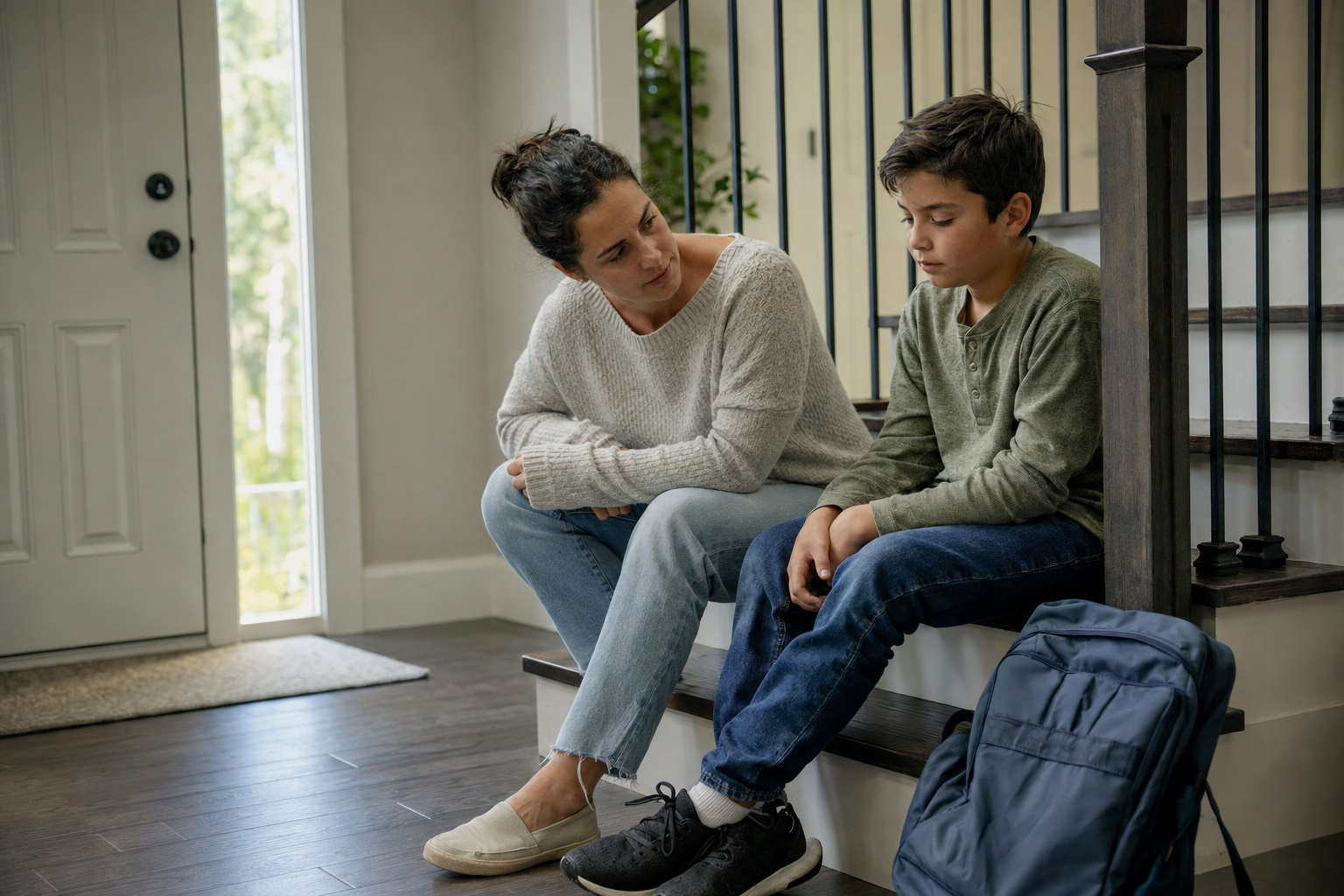
A concerned parent sits beside her worried school-age child near the front door on a school morning.
What Is School Avoidance?
School avoidance describes a pattern in which a child has difficulty going to school, remaining at school, or attending certain classes because of emotional distress or another underlying problem. You may also hear the terms school refusal, anxiety-related absence, or emotionally based school avoidance.
School avoidance is not itself a DSM-5-TR diagnosis. It is a behavior pattern that can have many causes. It also differs from truancy. A child who is truant typically tries to conceal the absence and may spend the day away from home. A child experiencing school avoidance is often at home with the parent’s knowledge, and the parent is usually working hard to get the child to attend.
Nationally, chronic absenteeism remains above its pre-pandemic level. Although children miss school for many reasons, anxiety, health complaints, academic difficulties, social stress, and feeling disconnected from school are important contributors.
Signs That a Child May Be Struggling
School avoidance does not always begin with a complete refusal. Early signs may include:
Frequent headaches, stomachaches, nausea, or fatigue that are worse on school days
Repeated requests to arrive late, leave early, or visit the school nurse
Tearfulness, irritability, or emotional outbursts before school
Trouble sleeping on school nights
Long delays while dressing, eating breakfast, or gathering belongings
Missing particular classes, tests, presentations, or unstructured times
A noticeable improvement in mood once staying home is allowed
Increasing absences following weekends, holidays, illness, or school transitions
Physical symptoms should never be automatically dismissed as “just anxiety.” A pediatrician can help rule out medical causes. At the same time, anxiety can produce very real physical discomfort even when no illness is found.
What Might Be Underneath the Behavior?
There is no single cause of school avoidance. One child may fear separating from a parent. Another may feel lost during reading instruction but be too embarrassed to say so. A third may be overwhelmed by noise, crowded hallways, changing classes, or unpredictable social situations.
Common contributors include:
Anxiety: separation anxiety, social anxiety, panic symptoms, fear of making mistakes, or worries about safety
Bullying or peer problems: teasing, exclusion, cyberbullying, or conflict with friends
Learning difficulties: reading, writing, or math demands that make each school day feel like repeated failure
ADHD or executive-function difficulties: forgotten assignments, chronic lateness, disorganization, correction from adults, and feeling constantly behind
Autism or sensory needs: social uncertainty, masking, noise, transitions, or an environment that feels unpredictable and exhausting
Depression: low energy, loss of interest, hopelessness, social withdrawal, or disrupted sleep
Trauma, grief, or family stress: events that reduce a child’s sense of safety or ability to cope
School-specific problems: conflict with a teacher, an overly demanding schedule, unsafe conditions, or inadequate support
Sometimes several factors are operating at once. This is why punishment alone rarely solves a persistent attendance problem.
Why Staying Home Can Become a Cycle
When children are highly distressed, allowing them to stay home can feel like the compassionate choice. In the moment, everyone’s anxiety drops. That relief is powerful. Unfortunately, it can teach the child’s brain that avoiding school is what made the fear go away.
The next morning, returning may feel even harder. Missed work accumulates, friendships become less comfortable, and the school building begins to feel more unfamiliar. This does not mean parents caused the problem. It means the family may need a planned approach that combines warmth with gradual movement back toward attendance.
What Parents Can Do
1. Stay calm and become curious
Instead of beginning with, “Why are you doing this?” try: “I can see that school feels really hard right now. Let’s figure out which part feels hardest.” Some children talk more easily while walking, riding in the car, drawing, or rating different parts of the day from easiest to hardest.
2. Look for patterns
Keep a brief record of absences, physical complaints, sleep, difficult classes, tests, peer events, and what happens immediately before the child asks to stay home. Patterns are often more informative than one difficult morning.
3. Contact the school early
Ask for a meeting before absences become firmly established. Helpful participants may include the teacher, school counselor, school psychologist, nurse, administrator, and special education staff. Share what you see at home and ask what staff members observe at school.
4. Develop a specific return plan
“Try harder tomorrow” is not a plan. Depending on the child’s needs, a plan might include greeting the child at the door, entering through a quieter location, checking in with a trusted adult, attending a shortened day temporarily, making up work gradually, or receiving support during the most difficult class. Any reduced schedule should have regular review dates and a thoughtful plan for increasing attendance.
5. Keep home safe but not more rewarding than school
If a child remains home, the day should be calm and structured—not filled with gaming, special treats, or unlimited entertainment. This is not punishment. It helps prevent staying home from becoming more appealing than returning.
6. Seek professional help when needed
Consult the child’s pediatrician when physical symptoms are frequent or unexplained. A mental-health professional can evaluate significant anxiety, depression, trauma, or escalating family conflict. If academic, attention, developmental, or learning concerns may be contributing, a comprehensive psychoeducational evaluation can help identify the barriers and guide school supports.
When to Act Urgently
Seek prompt professional assistance if your child talks about suicide or self-harm, appears severely depressed, has panic symptoms that cannot be managed safely, is being threatened or harmed, or has stopped attending for several consecutive days. In the United States, call or text 988 for immediate crisis support. Call 911 when there is an immediate danger.
A Final Thought
A child who cannot get through the school door is not necessarily lazy, manipulative, or unmotivated. The child may be communicating distress in the only way they currently know how.
Parents do not have to choose between compassion and attendance. The goal is to understand what is making school feel unmanageable, provide the right support, and help the child take achievable steps forward. The earlier the family and school work together, the easier that path is likely to be.
If learning, attention, developmental, or emotional concerns appear to be contributing to your child’s school difficulties, the Student Evaluation Center can help families better understand the child’s strengths and needs through a comprehensive psychoeducational evaluation.
Recommended Books
When Children Refuse School: A Cognitive-Behavioral Therapy Approach—Parent Workbook, Third Edition, Christopher A. Kearney and Anne Marie Albano. Oxford University Press, 2018. ISBN-13: 978-0190604080. This structured workbook is designed to be used with a qualified therapist.
Breaking Free of Child Anxiety and OCD: A Scientifically Proven Program for Parents, Eli R. Lebowitz. Oxford University Press, 2021. ISBN-13: 978-0190883522. A parent-focused guide to reducing accommodations that unintentionally maintain anxiety.
Verified Websites
American Academy of Pediatrics—School Avoidance:https://www.healthychildren.org/English/health-issues/conditions/emotional-problems/Pages/School-Avoidance.aspx
Attendance Works—Resources for Families:https://www.attendanceworks.org/resources/handouts-for-families/
Anxiety and Depression Association of America:https://adaa.org/
Child Mind Institute—School Refusal:https://childmind.org/article/when-kids-refuse-to-go-to-school/
988 Suicide & Crisis Lifeline:https://988lifeline.org/
This article provides general educational information and is not a substitute for individualized medical, psychological, or educational advice.
© 2026 Student Evaluation Center, LLC
